

Ben Salah Mosque
Ben Salah Mosque, also known as Ben Saleh Mosque, is a significant 14th-century Islamic monument situated in the historic medina of Marrakesh, Morocco. It stands as the sole major surviving structure from the Marinid era in the city and is particularly renowned for its exquisitely decorated minaret. The mosque's construction is believed to have taken place between 1318 and 1321 AD, likely under the patronage of Marinid Sultan Abu Sa'id Uthman, with the minaret's construction commencing in August 1321. The mosque is dedicated to a local saint, Muhammad ben Salah, and his tomb is located within its north-western corner.
The architectural design of Ben Salah Mosque features a rectangular courtyard, broad yet not excessively deep, encircled by arcades and centered around a small basin or fountain. Beyond this courtyard lies the main prayer hall, characterized by two rows of arches that delineate nine aisles. The layout follows a common "T"-type plan, where the aisle leading to the mihrab, a niche indicating the direction of prayer, is notably wider than the adjacent aisles. The interior is generally understated in its decoration, with the mihrab being the primary ornamental feature. Interestingly, the mosque's qibla orientation faces south-south-east, a significant deviation from the modern qibla in Morocco, which is almost due east towards Mecca. The mosque is accessible via three entrances.
The minaret is arguably the most striking and elaborately adorned component of the mosque. Its design draws inspiration from Almohad architectural styles, which were foundational to Moroccan-Andalusian architecture, and appears to be partly modeled after the Almohad minaret of Marrakesh's Kasbah Mosque. The upper facades of the minaret are embellished with darj-wa-ktaf or sebka patterns, reminiscent of palmettes or fleur-de-lys shapes, while the lower facades are dominated by large polylobed arch motifs. These intricate patterns are crafted in brick against a vibrant turquoise-green faience tile background. Each facade is pierced by three windows with horseshoe-shaped arches, harmoniously integrated with the surrounding arch patterns. The minaret's summit, including its upper lantern, is crowned with merlons, a characteristic element of Moroccan architecture. This decorative scheme served as a transitional example between Almohad designs and subsequent Moroccan architectural constructions.
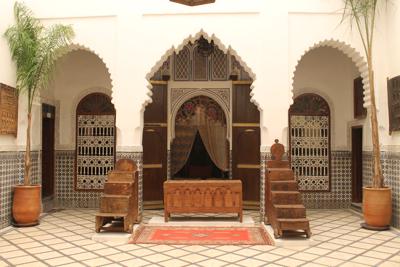
Adjacent to the mosque, an associated madrasa was erected by the Alaouite sultan Moulay Rashid between 1669 and 1671. This madrasa is organized around a large square courtyard, enclosed by a two-story gallery that provides access to numerous rooms. As of 2012, there were proposals to transform this madrasa into a museum dedicated to showcasing religious artifacts from the city's rich heritage, such as minbars and ancient manuscripts.
Quick Info
Own this place?
Claim it to update its details and photos, add what you offer, reply to travellers and promote it on Wapota. It’s free.
Claim this listing →


Weather & Rainfall Patterns
Station: 314n78w · 14.5 km away · 880m