
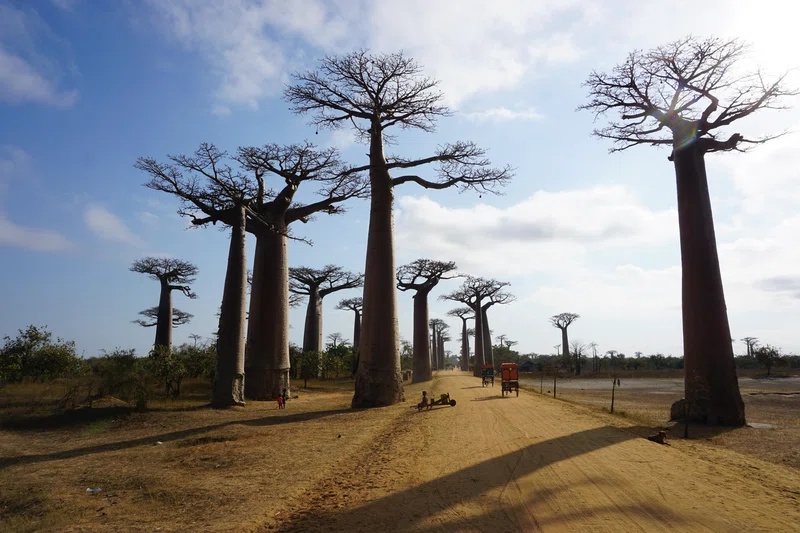
Allee Des Baobabs
The Avenue of the Baobabs, or Allée des Baobabs, is a breathtaking natural monument located in the Menabe region of western Madagascar, approximately 20 kilometers north of Morondava. This iconic landscape features a prominent group of majestic Grandidier's baobabs (Adansonia grandidieri) lining an unpaved section of Road No. 8. These ancient trees, some estimated to be over 800 years old and reaching heights of up to 30 meters, are locally revered as "Renala," meaning "mother of the forest". They are endemic to Madagascar and represent the last vestiges of dense tropical forests that once flourished in the area, which have since been cleared for agriculture, leaving these resilient giants standing. The baobabs possess distinctive smooth, bottle-shaped trunks and branches that only emerge at their crowns, a unique form that local legends attribute to deities planting them upside down. Their remarkable ability to store vast quantities of water, up to 100,000 liters, allows them to thrive through the region's alternating wet and dry seasons.The site is a major tourist attraction, particularly celebrated for its photographic opportunities, especially during sunrise and sunset when the changing light casts dramatic shadows and intensifies the colors of the trees and the surrounding red earth. It serves as a crucial stop for travelers exploring western Madagascar, often en route to or from the Tsingy de Bemaraha National Park or after a descent of the Tsiribihina River. While not a wildlife park, the baobab flowers, which bloom briefly, attract pollinators such as lemurs and bats. A community-managed facility at the southern entrance offers local handicrafts, baobab-derived products like jam and oils, a coffee shop, and clean restrooms, contributing to local economic development.Culturally, the baobabs hold significant spiritual value for the Malagasy people, who preserve them out of respect and for their practical uses as sources of food and building materials. A notable feature nearby is the "Baobab Amoureux" (Baobabs in Love), a pair of intertwined Adansonia za trees located about 7 kilometers northwest, which are central to a local legend of enduring love. Recognized for its ecological and cultural importance, the Avenue of the Baobabs was granted temporary protected status in 2007 and officially designated a natural monument under conservation in July 2015, encompassing an area of 320 hectares. Conservation efforts, supported by organizations like Conservation International and the Malagasy NGO Fanamby, are ongoing to protect this unique ecosystem and enhance the livelihoods of the local community.
Quick Info
Own this place?
Claim it to manage photos, respond to visitors, and promote it to travelers.
Claim this listing →





13-Day Andasibe - Tsiribihina- Baobab Alley - Ranomafana
0.0 km away
18-Day Baobab Avenue-Kirindy-Tsingy -Isalo-Ranomafana
0.0 km away
10-Day Tsiribihina River Expedition
0.0 km away
Weather & Rainfall Patterns
Station: 198s444e · 29 km away · -9999m