
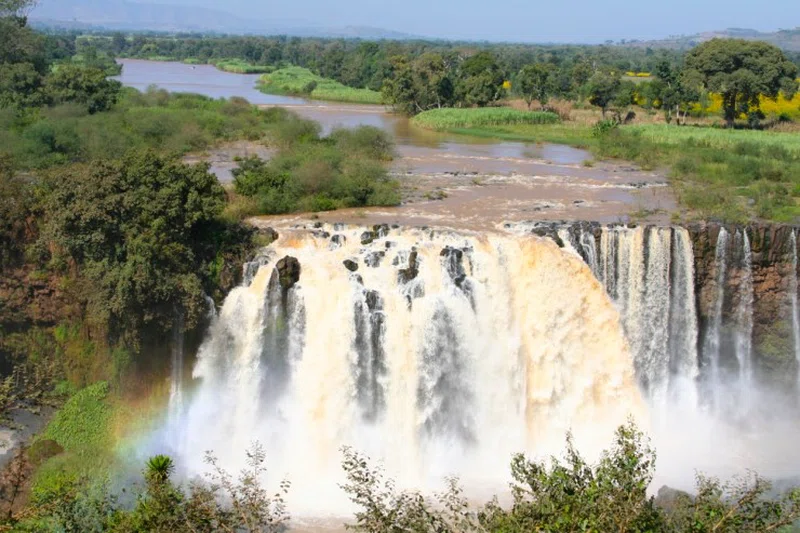
Blue Nile Falls
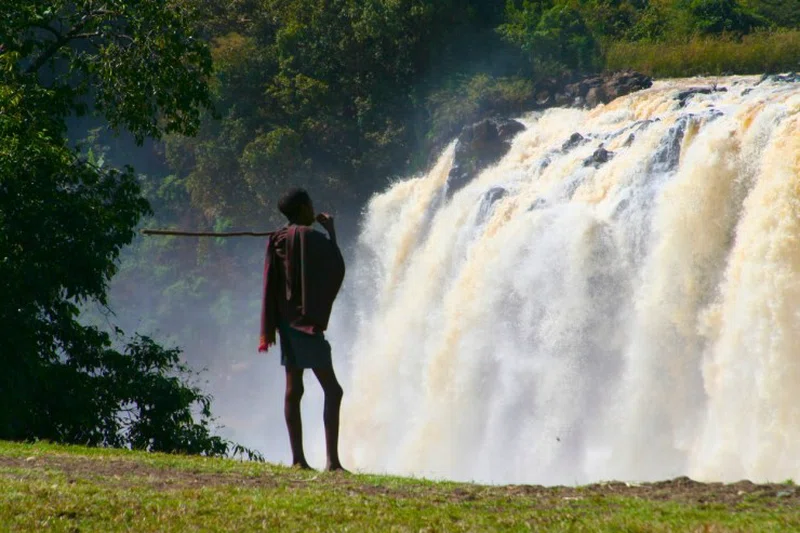
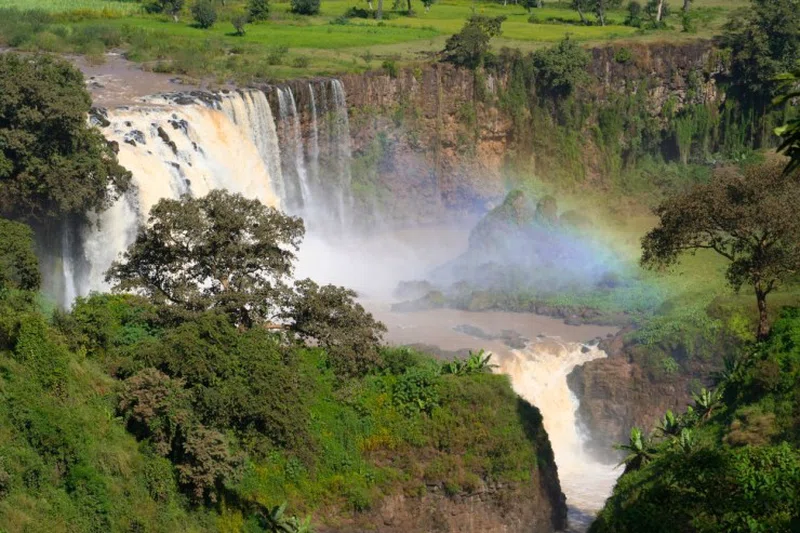
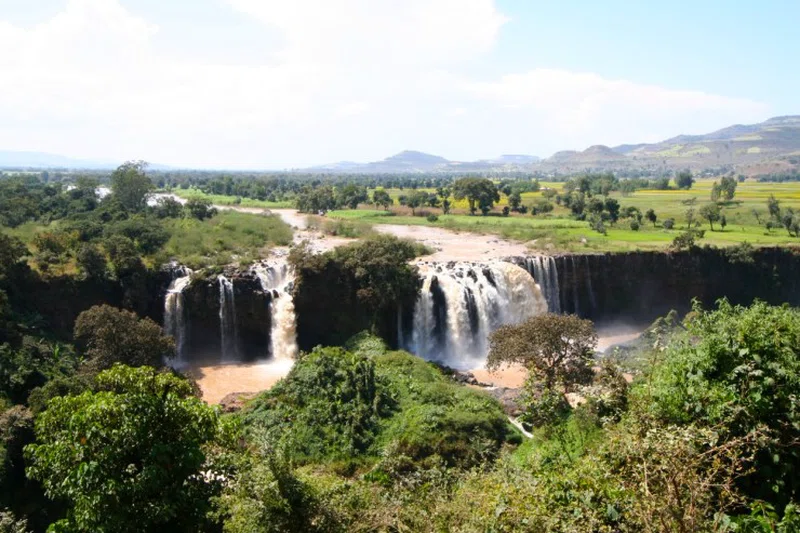
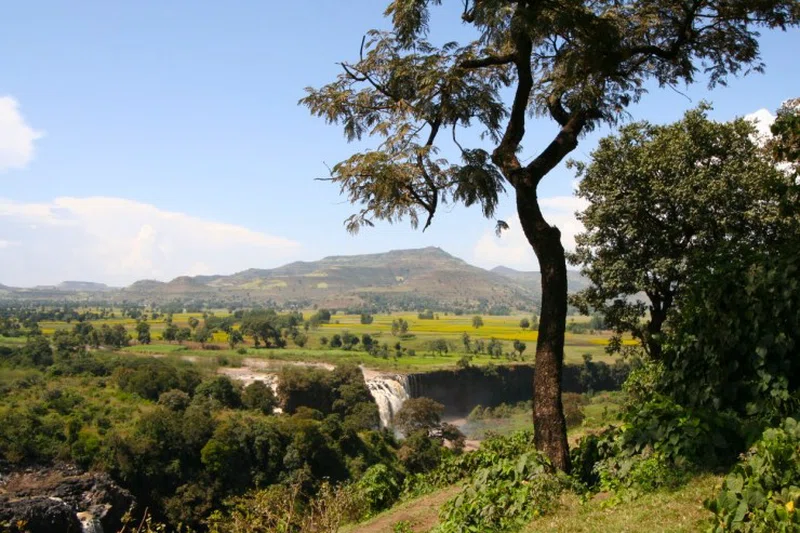
The Blue Nile Falls, known locally as Tis Abay or Tis Isat, meaning "great smoke" or "smoking water," are a prominent natural attraction in Ethiopia's Amhara Region. Situated on the upper course of the Blue Nile River, approximately 30 to 35 kilometers downstream from Bahir Dar and Lake Tana, these falls are a testament to Ethiopia's natural beauty. The falls plunge 42 to 45 meters (138 ft) into a frothing gorge, creating a spectacular display of mist and rainbows, particularly during the rainy season. While historically reaching widths of over 400 meters (1,300 ft) during peak flow, hydroelectric projects upstream have significantly reduced the water volume, especially in the dry season. The most impressive flow is typically observed from August to September, during Ethiopia's wet season, while from January to March, the falls are considerably less powerful. The Blue Nile itself, often brown with sediments rather than blue, has carved out a canyon in the region that rivals the Grand Canyon in length.Beyond their visual grandeur, the Blue Nile Falls hold ecological and historical significance. They have historically acted as a natural barrier, isolating the aquatic ecosystem of Lake Tana from the rest of the Nile, which has fostered the evolution of unique endemic fish species within the lake. A short distance downstream from the falls stands Ethiopia's first stone bridge, a 17th-century Portuguese structure built in 1626 under Emperor Susenyos. This historic bridge is an integral part of the hiking experience around the falls.Visitors can explore the falls via several hiking trails, typically taking 2 to 3 hours for a full circuit. Routes include a 1.5km footpath leading across the Portuguese bridge and through small hamlets to main viewpoints. In the dry season, a suspension bridge over the Alata River allows access to the base of the falls, offering the unique opportunity to walk behind the watery curtain and even swim in the pool below. The surrounding riverine forest is a haven for birdwatchers, with endemic and near-endemic species such as the blue-breasted bee-eater, white-cheeked turaco, black-winged lovebird, yellow-fronted parrot, and wattled ibis. Crocodiles may also be spotted during dry-season mornings. The falls are accessible from Bahir Dar, a city 484 km from Addis Ababa, with daily flights connecting the two. From Bahir Dar, the falls are a 30 km drive, and local buses or private vehicles can be arranged to reach the village of Tis Abay, the entry point for the falls. Most travelers opt to stay in Bahir Dar, which offers a range of accommodation options.
Quick Info
Own this place?
Claim it to manage photos, respond to visitors, and promote it to travelers.
Claim this listing →







2-Day Visiting Lake Tana Monasteries & Blue Nile
0.1 km away
Weather & Rainfall Patterns
Station: 114n375e · 9.7 km away · 2169m