

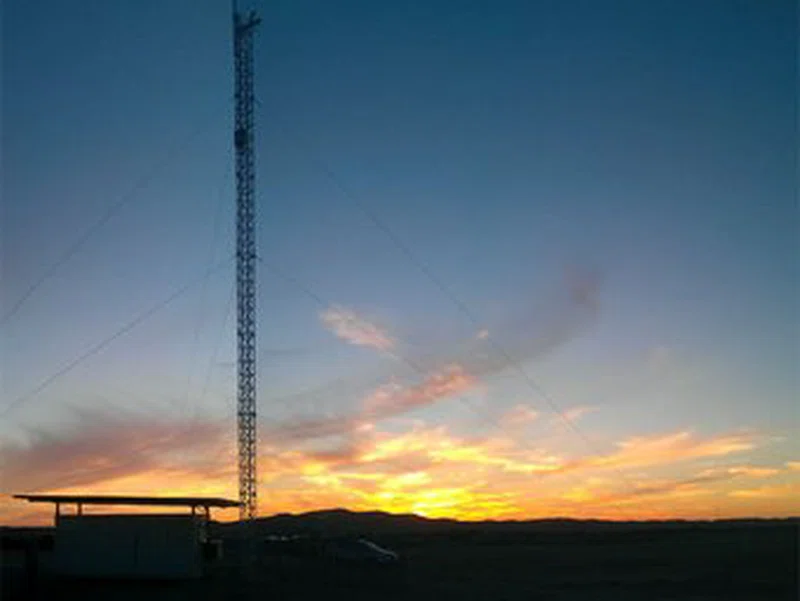
Gobabeb Training & Research Centre
The Gobabeb Training & Research Centre, also known as the Gobabeb Namib Research Institute, is an internationally recognized hub for dryland training and research, nestled deep within Namibia's hyperarid Namib Desert. Established in 1962 by Austrian entomologist Charles Koch, the center is located approximately 120 kilometers southeast of Walvis Bay, within the vast Namib-Naukluft National Park. Its unique geographical position at the convergence of three distinct ecosystems—the expansive Sand Sea to the south, the vast Gravel Plains to the north, and the life-giving ephemeral Kuiseb River—provides an unparalleled natural laboratory for scientific inquiry. Furthermore, Gobabeb lies within the inland edge of the fog zone, a critical climatic feature that significantly influences the desert's ecology and enhances the center's research capabilities. The site, which was formerly a Topnaar community called !Nomabeb, meaning "place of the figtree," is deeply embedded in the cultural landscape of the indigenous ≠Aonin (Topnaar) Nama pastoralists who have inhabited the Kuiseb River basin for centuries.Gobabeb's core mission is to serve as a catalyst for gathering, understanding, and disseminating knowledge about arid environments, with a particular focus on the Namib Desert. The institute conducts extensive research across various disciplines, including climate, ecology, geomorphology, desert organisms and their biodiversity, arid land ecosystems, and the prevention of desertification. It also investigates climate change, restoration ecology, appropriate technology, and sustainable livelihoods within arid environments. Annually, over 250 scientists visit Gobabeb to conduct research and test innovations, contributing to a body of nearly 2,000 publications over the past five decades. Beyond research, Gobabeb is committed to skills development, offering training courses and internships for students from primary school to post-graduate levels. These programs aim to enhance public awareness and knowledge of dryland ecology and environmental issues, fostering the next generation of environmental specialists and decision-makers.The center itself is a living demonstration of appropriate technology and sustainable living in a desert environment. It operates with a solar-diesel hybrid energy system, where over 90% of its energy for electricity and water heating is derived from solar power. Water recycling systems treat all sewage water for reuse, and innovative fog harvesting techniques collect significant amounts of water, a crucial resource in this hyperarid region. Buildings are constructed using clay bricks made from Kuiseb River silt, providing natural thermal insulation. Waste management practices include feeding organic waste to local Topnaar community goats and recycling other materials. Gobabeb also houses a comprehensive library, recognized as the most extensive collection on arid zone research in ecology and biology in sub-Saharan Africa. Since 1998, Gobabeb has operated as a joint venture between the Ministry of Environment and Tourism and the Desert Research Foundation Namibia, and it is the designated monitoring and research center for the Namib Sand Sea World Heritage Site.
Quick Info
Own this place?
Claim it to manage photos, respond to visitors, and promote it to travelers.
Claim this listing →
Weather & Rainfall Patterns
Station: 233s150e · 8.1 km away · 459m