Attraction in Egypt
Tomb of Mesu-Isis
About Tomb of Mesu-Isis
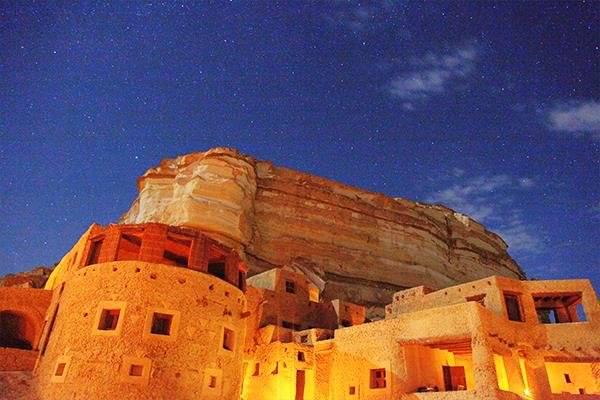
The Tomb of Mesu-Isis is a significant ancient burial site located within Gebel al-Mawta, also known as the "Mountain of the Dead," a prominent conical hill situated just north of Siwa Town in the Siwa Oasis, Egypt. The tomb itself is named after Mesu-Isis, the wife of the original owner, whose own name has become illegible over time. It is estimated to have been constructed between the 4th and 2nd centuries BC, placing its creation roughly contemporary with the renowned Tomb of Si-Amun, which lies approximately twenty meters to its east.
The entrance to the Tomb of Mesu-Isis faces north with a slight deviation towards the east. It is distinguished by a cornice adorned with twenty-one uraei, or stylized cobras, painted in vibrant red and blue, each surmounted by a sun-disk. Further embellishments include two painted winged sun-disks and hieroglyphic inscriptions on either side of the entrance. Inside, to the right of the entrance, there are depictions of the deities Osiris and Isis seated opposite each other. While some of the original colors are still preserved, the hieroglyphic texts have suffered partial damage. The inscriptions identify Osiris as "The foremost of the Westerners (the dead), and as the great god who is honored in 'Tha-t'," which is believed to be an ancient name for the Siwa Oasis or one of its specific localities.
Notably, the interior of the tomb was never fully completed, with most of its walls remaining unplastered and undecorated. Only the wall directly facing the entrance, where the burial chamber is carved, received partial painting. During the Roman Period, the tomb was repurposed, and several loculi, or burial niches, were cut into its side walls to accommodate family burials. The tomb was rediscovered in October 1940 by local Siwan inhabitants who sought refuge within the Gebel al-Mawta tombs during World War II air raids. Upon its discovery, some mummies were found interred within gilded plaster coffins.